
Plants
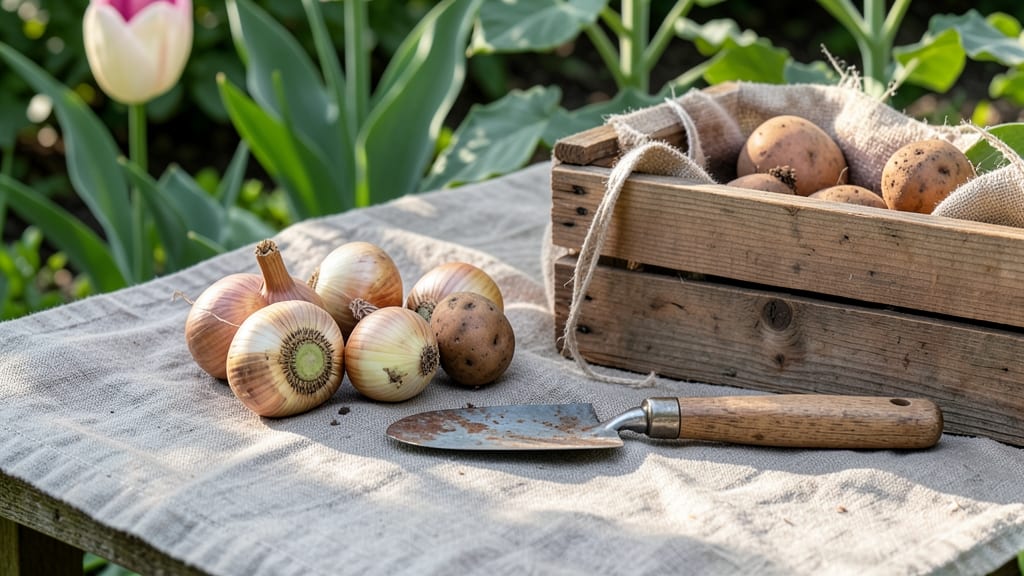
Bulbs and tubers in plants act as natural energy banks, storing nutrients underground to fuel regrowth after dormancy. Bulbs like tulips pack layered leaves rich in starch, while tubers such as potatoes expand stems or roots to hold excess sugars and nutrients.
These underground structures aren't just survival tools—they're also why your garden can bounce back year after year. 🌱 Bulbs focus on compact energy storage in tightly packed leaves, while tubers spread out starch reserves across thickened stems or roots.
Think of bulbs as nature's high-density batteries and tubers as slow-release nutrient depots. The key difference? Bulbs regrow from their base, while tubers sprout new shoots from their eyes or nodes.
For gardeners, understanding this means knowing when to plant and harvest. Most bulbs thrive when planted in fall for spring blooms, while tubers like sweet potatoes need warm soil and careful timing. Proper storage—cool, dry, and dark—keeps them viable until planting season.
The science behind these structures explains why some plants thrive in harsh conditions while others struggle, making them essential for both survival and cultivation.
💡 In This Article
- How Bulbs and Tubers Differ in Energy Storage
- Gardening Tips for Planting and Harvesting Bulbs and Tubers
How bulbs and tubers differ in energy storage
At the cellular level, bulbs and tubers store energy through fundamentally different biological adaptations. Bulbs like tulips and onions modify their leaves into concentric layers called scales, where each layer acts as a storage compartment.
These scales contain specialized parenchyma cells packed with starch granules and sugars, which can account for up to 70-80% of the bulb's dry weight. The outer scales also protect the inner growth center, ensuring survival even after the above-ground plant dies back.
Tubers, on the other hand, modify either stems (like potatoes) or roots (like dahlias) into thickened structures. Potato tubers, for example, develop from underground stems called stolons that swell with stored starch, reaching concentrations of 15-20% dry matter.
The key difference is that tubers store energy in lateral buds called "eyes", which are actually dormant shoots ready to sprout. These buds contain meristematic cells that remain metabolically active even during dormancy, allowing regrowth when conditions improve. 🌱
The chemical storage mechanisms also vary significantly. Bulbs primarily store energy as fructans (complex carbohydrates) and sucrose, which break down quickly during regrowth. Tubers, meanwhile, accumulate amylose and amylopectin (the starches that give potatoes their texture), along with proteins and vitamins.
This chemical difference explains why bulbs often regrow faster in spring—their stored sugars convert to energy more efficiently than tuber starches.
Seasonal adaptation plays a crucial role in how these structures function. Bulbs like garlic and onions enter dormancy when temperatures drop below 50°F, triggering the conversion of sugars into storage compounds.
Tubers, however, often require a period of cold stratification (like potatoes in 40-50°F soil) to break dormancy and initiate sprouting.
This explains why planting bulbs in fall and tubers in spring aligns with their natural cycles—bulbs need time to establish roots before winter, while tubers need warm soil to metabolize stored starches.
Consider the texture contrast: a sliced onion bulb reveals crisp, papery layers, while a potato tuber has a dense, mealy interior. This physical difference reflects their storage functions—bulbs prioritize compact, layered storage, while tubers expand into bulky reservoirs.
The trade-off? Bulbs are more efficient at rapid regrowth, while tubers provide long-term, slow-release energy. This is why tulips bloom so quickly in spring, while potatoes take weeks to sprout after planting. 🌿
One fascinating exception is the rhizome, a hybrid structure found in plants like ginger and irises. Rhizomes store energy in horizontal stems that combine aspects of both bulbs and tubers, with segmented nodes containing both starch and growth buds.
This hybrid structure explains why ginger "roots" can regrow from even small fragments—each node contains a mini energy bank and growth center.