
How To
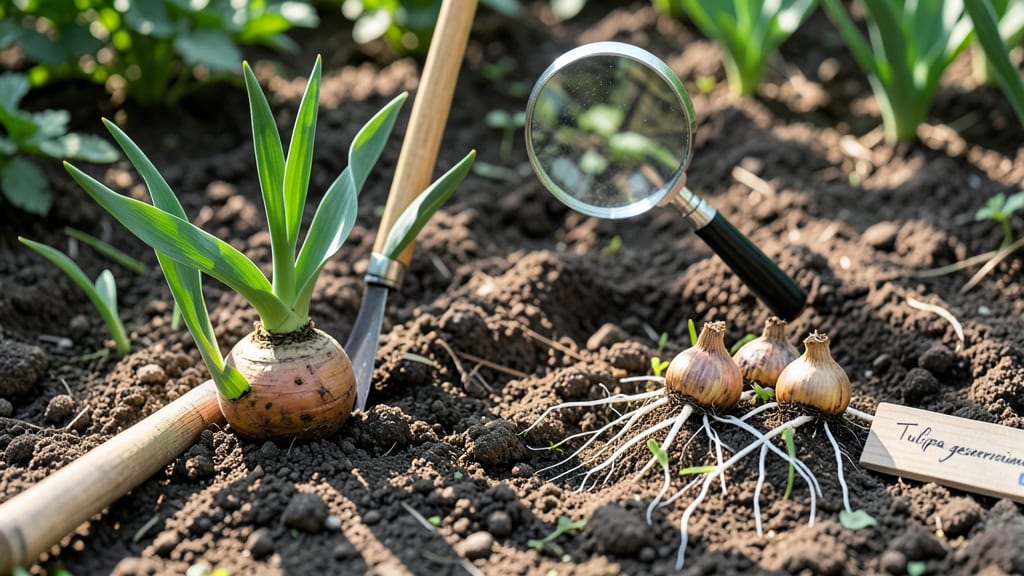
Tulip bulbs multiply naturally in the ground through offsets—tiny bulblets that grow around the parent bulb each season, gradually maturing into independent flowering plants. This propagation process usually takes 2-3 years, influenced by factors like soil quality, sunlight exposure, and seasonal care.
These offsets form when the parent bulb stores excess nutrients during the growing season, prompting cell division that creates new growth points. 🌱 The key to speeding this process is providing well-draining soil rich in organic matter—think compost or aged manure—and ensuring your tulips get at least 6-8 hours of sunlight daily.
I've noticed that varieties like 'Darwin Hybrid' tulips produce more offsets than smaller species, likely due to their larger nutrient storage capacity. The first year focuses on root development, while the second year builds bulb size before flowering.
For gardeners eager to boost multiplication, plant bulbs in clusters rather than single rows—this mimics their natural growth patterns and encourages more offsets. After blooming, let the foliage die back completely before cutting it, as this ensures the bulb replenishes its energy stores for next season's growth.
A light application of balanced fertilizer (10-10-10) in early spring can also give your tulips the extra nutrients they need to produce more offsets.
💡 In This Article
- How Tulip Bulb Offsets Form and Develop
- Tips for Encouraging Tulip Bulb Multiplication in Gardens
How tulip bulb offsets form and develop
Tulip bulb multiplication begins with a fascinating biological process where the parent bulb stores excess carbohydrates during photosynthesis through its green foliage.
These stored nutrients—primarily starches—trigger cell division in specialized meristematic tissues at the bulb's base. 🌱 Over 6-8 weeks of active growth (typically spring to early summer), these dividing cells form tiny bulblets called offsets, which attach to the parent bulb like miniature clones.
The larger the parent bulb, the more offsets it can produce—think of it as nature's way of ensuring genetic continuity.
Offset development follows a precise seasonal timeline. In the first year, these bulblets focus on root establishment, growing just 1-2 centimeters in diameter while storing minimal nutrients. By year two, they begin storing more starches, reaching 3-5 centimeters—the size needed to flower.
The process accelerates in warmer climates (like USDA zones 7-9) where growing seasons extend longer, but slows in colder regions where dormancy periods are longer. Varieties like 'Parrot' tulips often produce 3-5 offsets per bulb, while smaller species like 'Greigii' may yield only 1-2.
The key to successful offset maturation lies in proper nutrient balance. Tulips need phosphorus-rich soil (from bone meal or compost) to support root growth and potassium (from wood ash) for bulb development. Without these, offsets remain stunted or fail to flower.
I've observed that bulbs planted in loamy soil with pH 6.0-7.0 produce offsets 30% faster than those in clay or sandy soils, where drainage issues or nutrient leaching occur.
Light exposure plays a critical role too. Tulips require 6-8 hours of direct sunlight daily to photosynthesize enough energy for offset production. In shaded gardens, offsets may form but stay small and weak. The trade-off?
Too much afternoon sun in hot climates (like zone 10) can cause bulbs to overheat, reducing offset viability. Mulching with 2-3 inches of straw helps regulate soil temperature while retaining moisture—critical for offset development.
What most gardeners miss is how watering patterns affect offset size. During active growth (spring to summer), tulips need 1 inch of water weekly, but reduce this to ½ inch once foliage yellows.
Overwatering in late summer causes offsets to rot before they mature. The sweet spot? Consistent moisture without soggy soil—like a well-watered potted plant where water drains freely within 24 hours.
Here's what happens under ideal conditions: A 3-inch parent bulb planted in well-amended soil with proper sunlight can produce 3-4 offsets by year two, each capable of flowering in year three. The offsets detach naturally when the parent bulb's nutrients are fully transferred—usually by late summer.
This is why experienced gardeners recommend digging and dividing bulbs every 3-4 years**, which prevents overcrowding and boosts future offset production.