
Plants
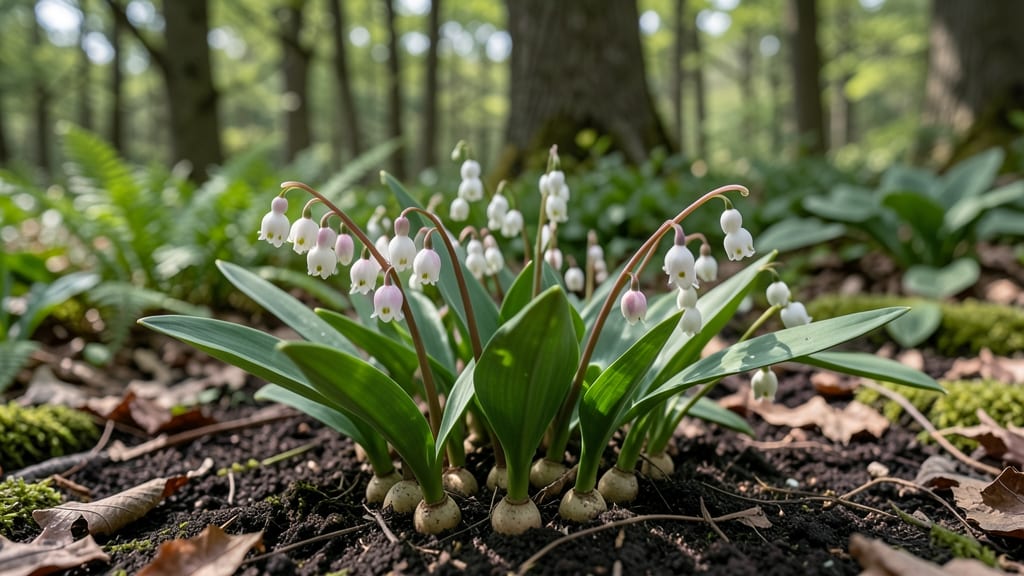
Lily of the valley bulbs look like small, flat, oval-shaped rhizomes rather than true bulbs, with scaly, brownish skin and a creeping growth habit. Their above-ground leaves appear as long, narrow, lance-shaped foliage emerging in early spring.
These unique underground stems—often mistaken for bulbs—grow horizontally just below the soil surface, forming clusters that spread over time. 🌱 Unlike traditional bulbs like tulips, they lack the layered, onion-like structure, instead resembling elongated, flattened roots with a rough, papery texture.
The above-ground leaves, which appear before the iconic bell-shaped flowers, are another key identifier: they grow in pairs from the rhizome, creating a distinctive fan shape that's easy to spot in shaded garden beds.
When digging, you'll notice how these rhizomes connect to form a network, which explains why lily of the valley spreads so aggressively. The brownish, scaly exterior protects the plant's delicate growth points, while the creeping habit allows it to colonize new areas each season.
This makes them perfect for ground cover but requires careful management if you want to control their spread.
For gardeners, recognizing these features helps distinguish lily of the valley from invasive weeds or other perennials. The combination of flat rhizomes and paired leaves creates a signature look that's hard to confuse with anything else in most landscapes.
💡 In This Article
- Lily of the Valley Rhizomes vs True Bulbs: Key Differences
- Identifying Lily of the Valley in Soil: Visual and Textural Clues
Lily of the valley rhizomes vs true bulbs: key differences
The confusion between lily of the valley's rhizomes and true bulbs stems from their superficial similarities, but botanically, they're fundamentally different. True bulbs—like those of tulips or onions—store nutrients in concentric layers, forming a round, layered structure.
In contrast, lily of the valley's underground stems are rhizomes: flat, elongated, and horizontally spreading. These rhizomes measure about 1-2 inches long and 0.5-1 inch wide, with a papery, brownish exterior that feels slightly rough to the touch, almost like crumpled parchment.
What sets them apart is their growth pattern: rhizomes grow along the soil surface, producing new shoots at nodes along their length, while true bulbs grow vertically and produce offsets at their base. 🌱 The rhizome's texture is also distinct—it lacks the firm, bulbous feel of a tulip bulb, instead resembling a flattened, scaly root.
This horizontal growth habit explains why lily of the valley spreads so rapidly in gardens, forming dense colonies. Unlike daffodils or hyacinths, which have distinct bulb layers, these rhizomes connect in a chain-like fashion, creating a network that's easy to trace when you dig them up.
Another key difference lies in their root systems. True bulbs develop roots from their base, while lily of the valley rhizomes produce roots along their entire length, giving them a more fibrous appearance. This root structure allows them to thrive in shaded, moist conditions where many bulbous plants would struggle.
The rhizome's scaly exterior isn't just for show—it protects the delicate growth points from soil-borne diseases and physical damage, much like how a snake sheds its skin to grow.
When comparing to other plants, think of it this way: if a tulip bulb is like an onion, a lily of the valley rhizome is more like a potato's eyes—flat, elongated, and connected in a chain.
This distinction matters for gardeners because it affects how you divide and transplant the plant. True bulbs can be carefully separated by their layers, while rhizomes must be cut between nodes to encourage new growth.
The rhizome's horizontal nature also means it's more susceptible to damage from deep cultivation, which can sever these delicate connections.
Here's a quick comparison to help visualize:
- True Bulbs (e.g., tulips): Round, layered, vertical growth with roots at base
- Rhizomes (e.g., lily of the valley): Flat, elongated, horizontal growth with roots along length
- Texture: Bulbs firm and layered; rhizomes papery and scaly
- Spread: Bulbs grow upward; rhizomes spread outward
Understanding this difference helps explain why lily of the valley behaves differently in your garden. While true bulbs might sit dormant underground for months, these rhizomes stay active, constantly sending out new shoots and roots to expand their territory. 💫